
What you need to know
Choosing between particle board and MDF (Supawood) for your kitchen cupboards isn’t about one being better. Discover the facts, practical uses and how to ask the right questions.
Understanding Particle Board and MDF in South African Kitchens
When planning your kitchen or built-in cupboards, choosing the right substrate material is crucial. Particle board (often called chipboard) and MDF (medium-density fibreboard, commonly known locally as Supawood) are two engineered wood products widely used in South African cabinetry. Despite common sales claims, neither material is inherently superior; each is engineered for specific purposes with distinct properties.
This article aims to bust myths and provide clear, practical information for South African kitchen buyers. We’ll explain what these materials are, how they differ in manufacture and performance, and how best to use them in your kitchen cupboards and shelves.
What Are Particle Board and MDF? Key Differences in Composition and Manufacture
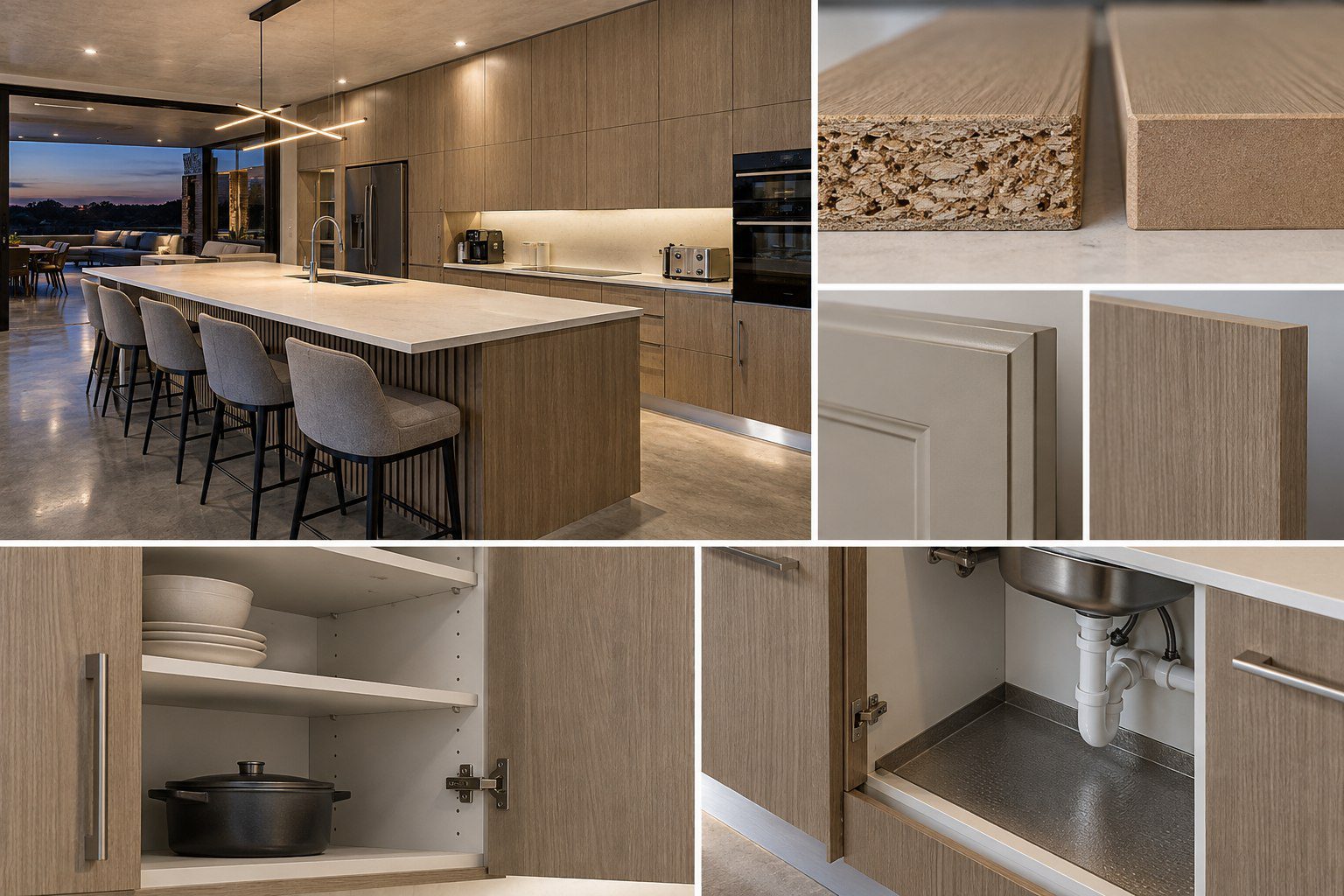
Particle board is made by compressing wood chips, shavings and sawdust with a synthetic resin binder under heat and pressure. The particles are relatively large and irregular, giving the board a coarse internal structure.
MDF, including the popular Supawood brand in South Africa, is manufactured from much finer wood fibres that are broken down to a uniform consistency before being bonded with resin and compressed. This results in a dense, smooth, fine-grained panel.
Because of these differences, particle board has a rougher texture and less uniform internal structure, while MDF’s fine fibres create a smooth, consistent surface ideal for detailed machining and finishing.
Why Neither Particle Board nor MDF Is Automatically Better
It’s a common misconception that MDF is always the superior choice for kitchen cupboards. In reality, both materials have strengths and weaknesses, and their suitability depends on the application.
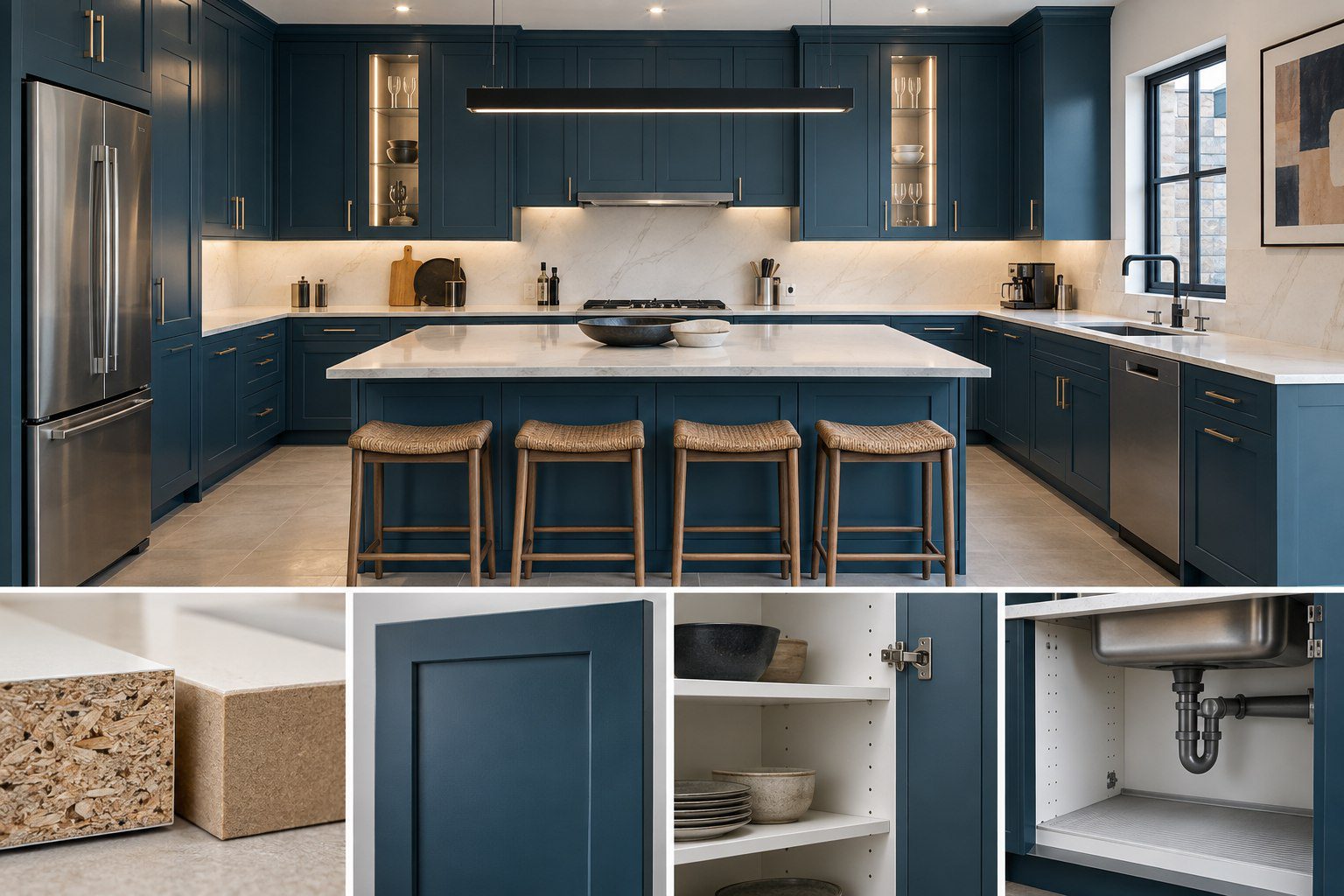
MDF’s fine fibres make it excellent for smooth painted or wrapped cupboard doors with routed or profiled edges. Particle board, especially when faced with melamine, is widely and economically used for cupboard carcasses, cabinet sides, fixed and adjustable shelves, and flat melamine-faced doors.
Choosing the right material involves considering factors such as finish quality, machining requirements, thickness, weight, screw retention, cost, and availability.
Finish Quality and Machining: MDF’s Advantage for Decorative Doors
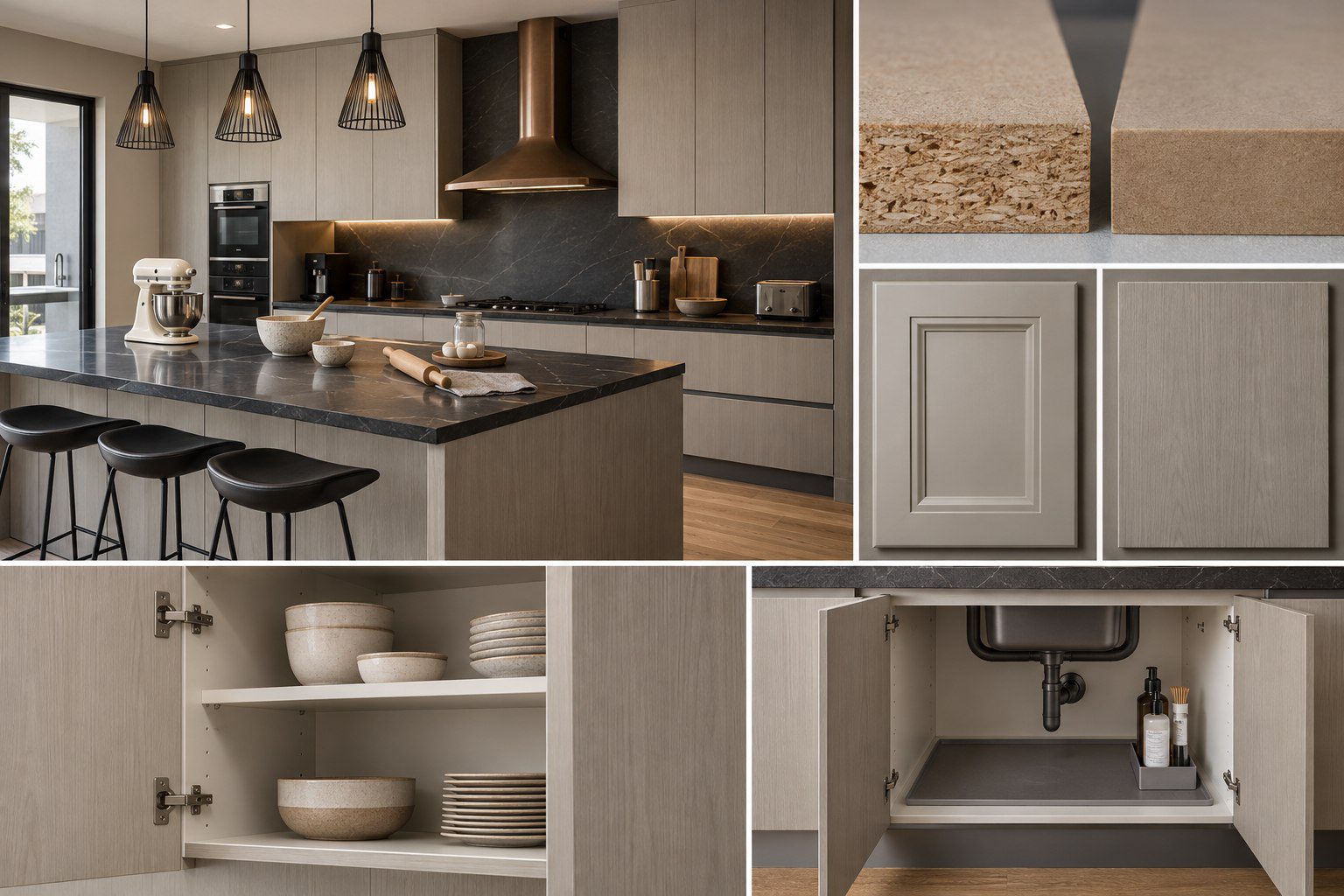
MDF’s uniform fine fibres produce smooth faces that accept paint and wrap finishes exceptionally well. This makes it the preferred substrate for painted or wrapped cupboard doors with decorative profiles or routed edges, such as Shaker-style doors popular in farmstyle kitchens.
The clean machining and routing possible with MDF allow for crisp, detailed door profiles without the rough edges or chipping sometimes seen with particle board.
However, MDF doors tend to be more expensive due to the material cost and additional finishing labour.
Particle Board’s Role in Economical Cupboard Carcasses and Shelving
Melamine-faced particle board is the workhorse of South African kitchen carcass construction. It is widely used for cupboard sides, fixed and adjustable shelves, and flat melamine-faced doors because it offers good durability at a lower cost than MDF.
Particle board panels are generally lighter than MDF of the same thickness and can be easier to screw into initially, but care must be taken to avoid overtightening screws which can reduce holding power over time.
Particle board’s rougher surface and larger particles make it less suited to detailed machining or painted finishes but ideal for flat, melamine-faced surfaces.
Comparing Particle Board and MDF: Key Characteristics
The table below summarises the practical differences between particle board and MDF relevant to South African kitchen applications.
Strength, Stiffness and Shelf Sag: Why It’s Not a Simple Comparison
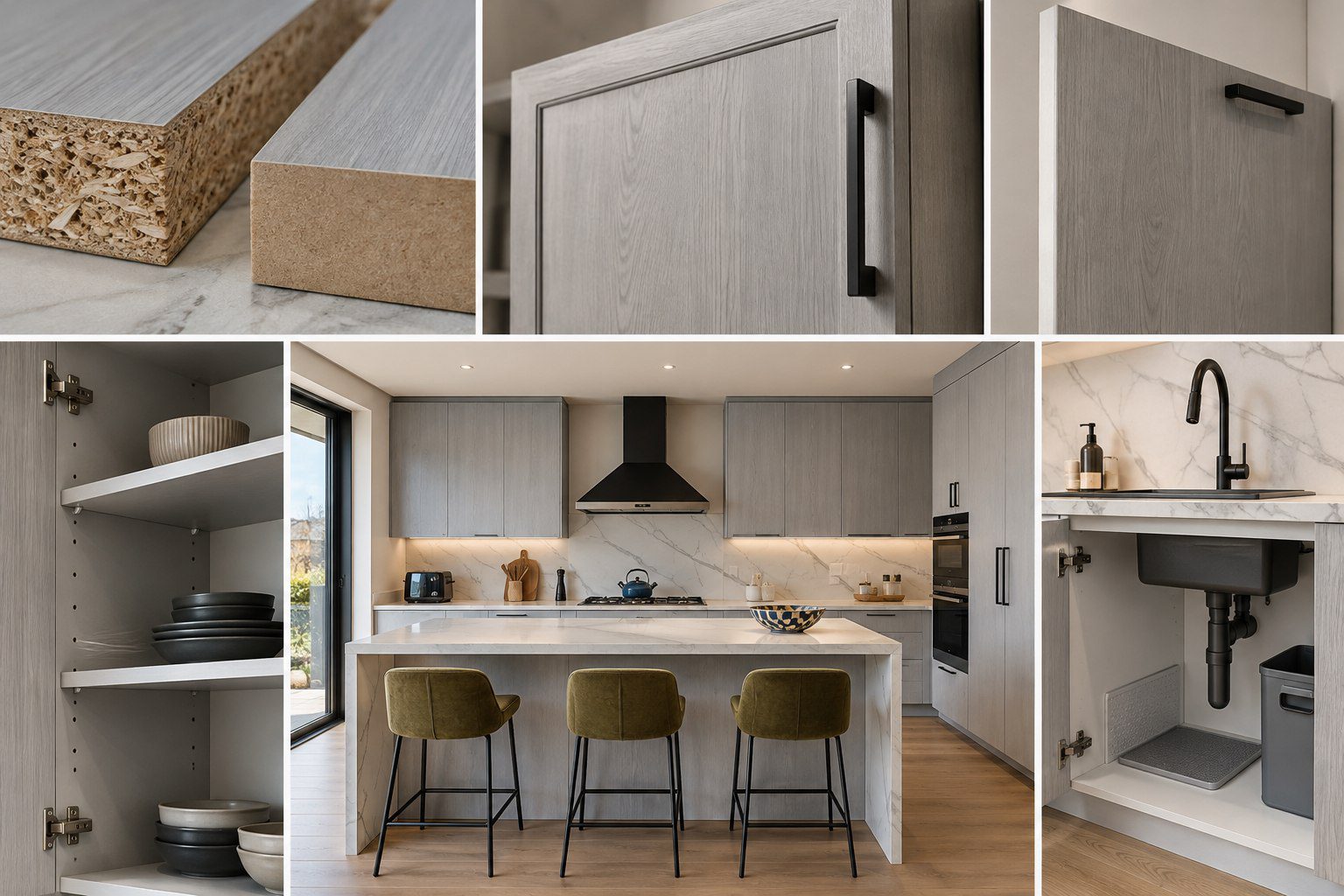
Strength and stiffness depend on multiple factors including board grade, thickness, unsupported span, loading, edge reinforcement and support layout. Neither particle board nor MDF can be universally ranked as stronger or stiffer.
Stiffness refers to how much a shelf deflects under load, while breaking strength is the load at which the board fails. Both are important but distinct properties.
Weizter’s workshop experience with locally sourced 16 mm panels has shown that some MDF panels can exhibit more visible deflection under cupboard-shelf loads than equivalent particle board panels. However, this is not a universal property and may reflect differences in board grades, surface treatments, loading conditions, support, or product quality.
For shelving, appropriate thickness, support spacing and edge reinforcement are more critical than the substrate name alone.
Moisture Performance: Both Materials Need Protection
Standard MDF and particle board panels are susceptible to swelling and deterioration if water penetrates the board. Neither should be sold or considered waterproof.
Moisture-resistant grades exist for both materials but still require careful edge sealing, joint detailing, and installation quality to prevent water damage.
In kitchen environments, particularly around sink bases and vanity areas, sealing exposed edges and prompt repair of leaks or standing water are essential to prolong board life.
Good moisture protection depends more on substrate selection, grade, edging, installation quality and application than on the material name alone.
Practical Applications: Which Material for Which Kitchen Component?
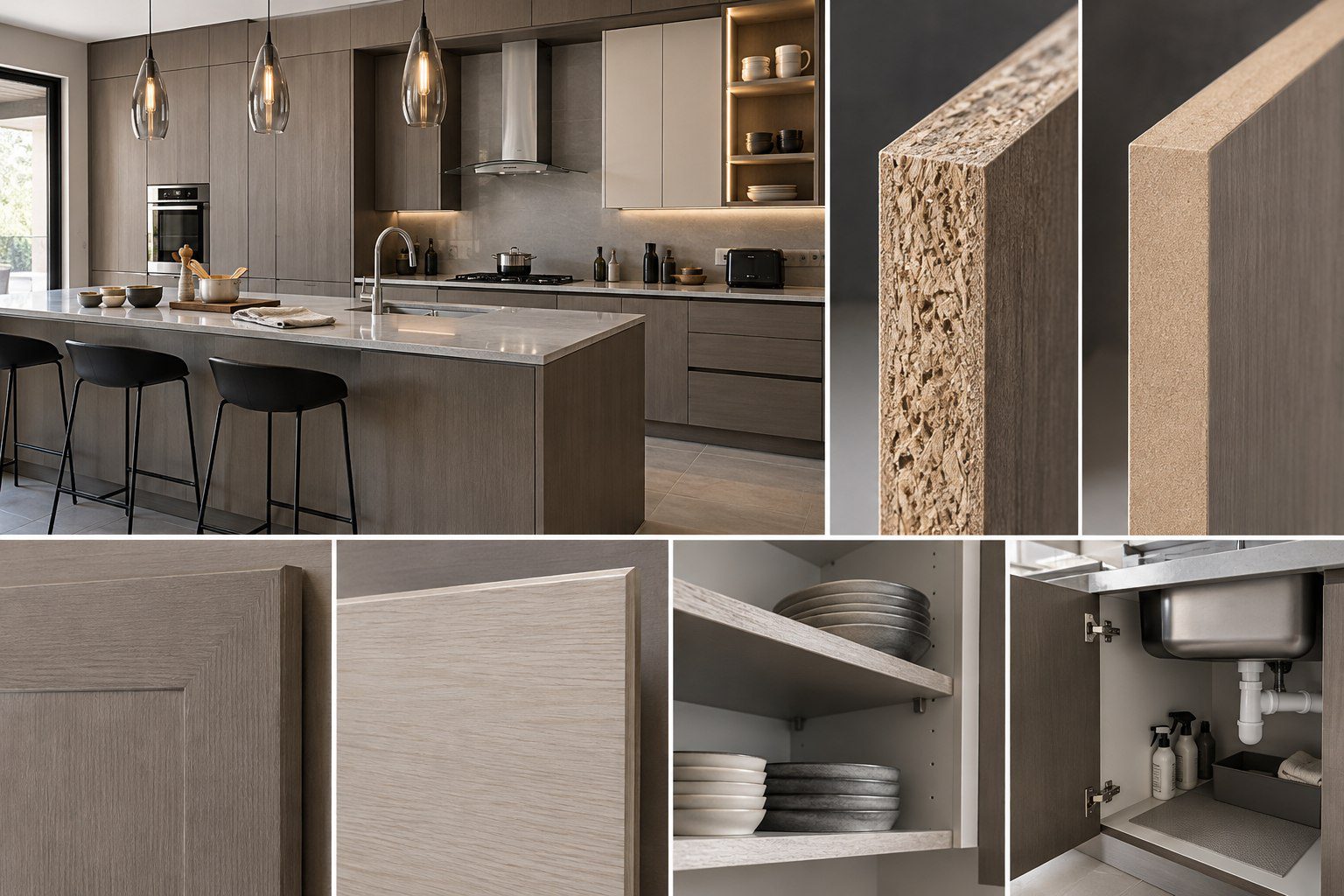
Doors: MDF (Supawood) is preferred for painted, wrapped or profiled doors due to its smooth surface and clean machining. Particle board is suitable for flat melamine-faced doors where cost is a priority.
Carcasses and Cabinet Sides: Melamine-faced particle board is widely used for carcasses and sides because of its durability and cost-effectiveness.
Shelves: Both materials can be used for shelves, but thickness, support and grade must be fit for purpose. Particle board shelves may offer better initial screw grip, but MDF shelves can be more dimensionally stable if properly supported.
Large Spans: Shelf sag depends on thickness, span and support rather than material alone. Increasing thickness or adding supports is the best way to reduce deflection.
Weizter Workshop Observations on 16 mm Panels and Fixings
At Weizter, we have observed that some locally sourced 16 mm MDF panels show more visible deflection under cupboard shelf loads than equivalent 16 mm particle board panels. This is an observed outcome in specific supply batches and installation conditions, not a universal property of MDF.
Particle board fixings often have a stronger initial screw bite but can lose holding power quickly if screws are overtightened or repeatedly removed. This behaviour highlights the importance of correct installation techniques.
Pilot holes, suitable screw types, torque control, maintaining adequate edge distances and understanding screw withdrawal versus thread stripping are critical for both materials.
These practical site observations contrast with published manufacturer specifications, which show overlapping ranges for modulus of elasticity and bending strength but do not confirm universal superiority of either material.
Reported differences in shelf deflection may reflect variations in board grade, surface treatment, loading, span, orientation, support and product quality rather than inherent material properties.
Manufacturer data does not provide screw-withdrawal figures for particle board, so no certified head-to-head screw retention winner can be declared.
We advise buyers to focus on fit-for-purpose 16 mm boards for carcasses and shelving, ensure appropriate support spans, and specify MDF for smooth decorative routes and paint finishes rather than relying on marketing slogans.
Questions to Ask Your Kitchen Designer About Board Specification
To ensure your kitchen cupboards meet your expectations and needs, ask your designer or supplier these practical questions:
• What is the exact board type, brand and grade being specified for carcasses, shelves and doors?
• What thickness and moisture resistance rating do the boards have?
• What edge banding or edging materials are used?
• How are shelves supported and what is the maximum recommended load and span?
• What screw types and installation methods will be used to ensure long-term fixing strength?
• For painted or profiled doors, is MDF (Supawood) being used, and what finishing process is applied?
• What precautions can be taken at moisture-sensitive areas like sink bases and vanities to prevent water damage?
Being informed about these details helps avoid surprises and ensures your kitchen is both beautiful and durable.
Balanced Conclusion: Choosing Materials Based on Application, Not Marketing
In summary, particle board and MDF (Supawood) each have their place in South African kitchen cabinetry. Neither is automatically better; rather, each is engineered for different purposes.
MDF excels for smooth, painted or wrapped decorative doors with profiled edges, while melamine-faced particle board offers an economical, durable solution for carcasses, shelves and flat doors.
Strength, stiffness and moisture resistance depend on board grade, thickness, installation quality and application rather than material name alone.
Weizter’s workshop experience highlights real-world performance nuances that buyers should consider alongside manufacturer specifications.
By asking informed questions and understanding the practical differences, you can make the best choice for your kitchen’s needs without falling for oversimplified sales claims.
Ultimately, substrate selection, board grade, edging, installation quality and intended application matter far more than sales talk.
Frequently asked questions
Is MDF always stronger than particle board for kitchen shelves?
No. Strength and stiffness depend on board grade, thickness, span, support and loading. Both MDF and particle board have multiple grades with overlapping performance. Shelf sag is influenced more by thickness and support layout than material alone.
Can I use MDF or particle board in wet areas like under the sink?
Standard MDF and particle board are not waterproof and will swell if exposed to water. Moisture-resistant grades exist but still require proper edge sealing, joint detailing and prompt leak repair. Avoid standing water and ensure good installation practices.
Why do MDF doors cost more than particle board doors?
MDF’s fine fibres allow smooth surfaces and clean routed or profiled edges ideal for painted or wrapped finishes, which require more labour and material quality. Particle board doors are usually flat and melamine-faced, making them more economical but less suited to detailed finishes.
What screw types and installation methods are best for particle board and MDF?
Use pilot holes, suitable screws designed for chipboard or MDF, control screw torque to avoid overtightening, and maintain adequate edge distances. Particle board may have stronger initial screw bite but can lose holding power if screws are overtightened or removed repeatedly. MDF is less prone to thread stripping but still needs correct installation.
How do I know if my kitchen carcass boards are fit for purpose?
Ask your kitchen designer for the exact board type, grade, thickness and moisture rating. Check how shelves are supported and the maximum recommended load and span. Properly specified 16 mm boards with good support and installation will perform well regardless of being MDF or particle board.
Start your project with Weizter
Explore our services: Modern Kitchens · Contemporary Kitchens · Farmstyle Kitchens · Kitchen Gallery.